
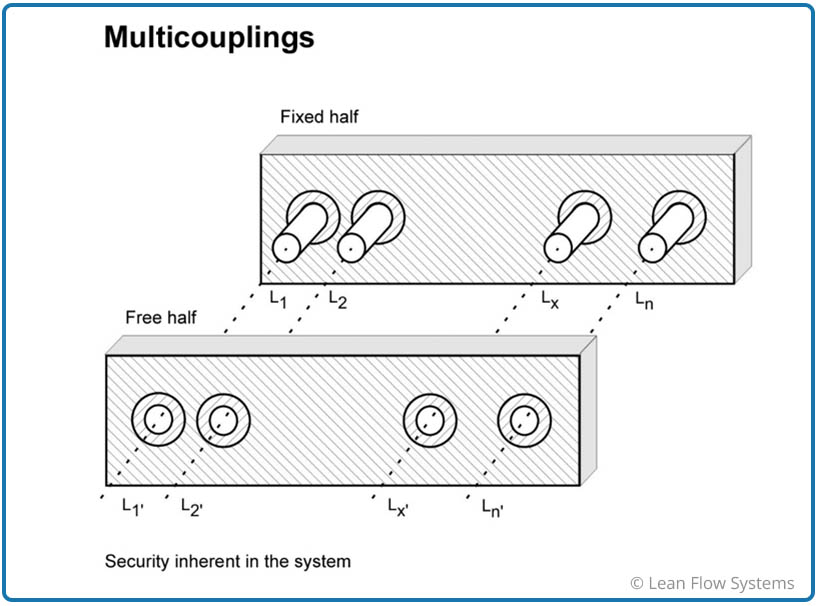
Figure 1, Preventative Design
We live in a world where errors are a common part of life. People, for all their brilliance, get tired, lose attention and make mistakes. Error Proofing builds preventative design into a process so that it is impossible to physically move forward if a mistake is made. Following are some Error Proofing categories:
Multicoupling (see figure above) – Connections that will only mate up in the correct orientation (additional example: diesel and gas pump nozzles have different diameters that match the vehicle gas cap opening).
Field Qualification – Algorythms that ensure all fields are filled out before progressing to the next step (ex. filling out a job application form online).
Multi Matching – Make something be repeated correctly twice or more before continuing to the next step (ex. new password).
Kitting – Count out and sequence the correct number of items ahead of time to ensure the right quantity is being installed in the correct order – sometimes linked to automatic counting or weighing mechanisms to ensure the kit preparation is done correctly.
Light Curtain – Technology that ensures a part has been pulled (“positive break”) or a machine is shut down for safety (“negative break”).
Separation – Physical separation of an activation device from a dangerous source to prevent injury (ex. garbage disposal switch far enough away from disposal to ensure the person’s hand can’t reach it upon startup).
Our client, Essilor, the global leader in ophthalmic lenses, was having a problem shipping completed prescription glasses to the wrong Eye Care Practices (ECP). On a typical day a medium size lab will ship 2800 orders to 500 different ECP’s. All these shipments are via parcel, typically UPS or a local carrier. One lab was averaging 5 miss shipments per day, for a defect rate as follows:
5 errors per day / 2,700 orders per day = .185% = 1,850 parts per million (ppm)
This may not sound like a lot, but it is less than 5 sigma for a very simple process – “put the order in the correct box”. And it causes a great deal of customer angst and operating costs to fix. Figure 2 shows the ppm for various sigma ranges.
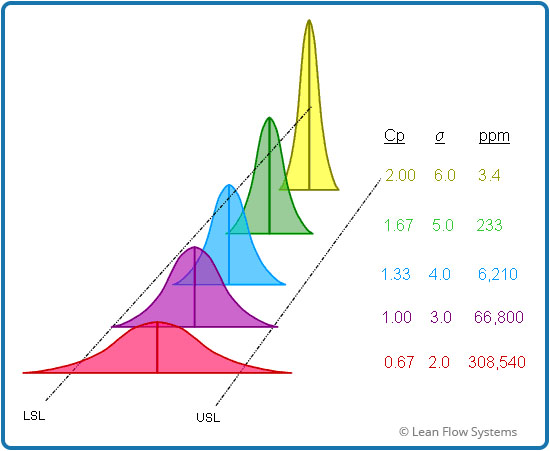
Figure 2, Sigma vs Parts Per Million
The two major reasons for the shipment error were as follows:
We were already testing a solution for the first reason by invoicing orders one by one in the finishing cells, and it was reducing this source of error. But we had no solution for the second reason. That is when we decided to design and test a “Ship to Light” concept.
Figure 3 illustrates the basic design. Orders come from the cell presorted into shipping bin ranges (for example, all ship bins 5000 to 5999 put together). The operator then scans the barcode of each job and a series of lights indicate the slot to put the job in. A similar concept was benchmarked at another lab that had made shipping accuracy improvements.
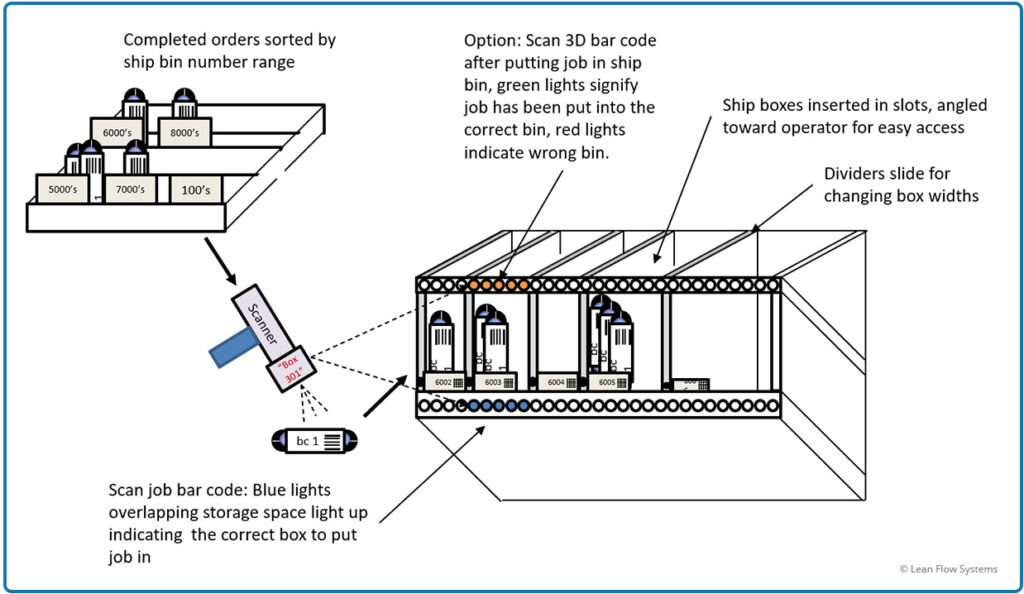
Figure 3, Ship to Light Concept